Sequences

Sales Sequences for Telecoms Teams

Set the follow-up plan once, then let it run until you log a reply or the deal moves on.

Do not let a deal stall in silence

A quote goes out. The customer means to reply and does not. The rep means to chase and gets busy. Three weeks later the deal is dead, and nobody made a decision at any point.

Sequences fix the follow-up by taking it off the rep's memory. You write the plan down once: an email on day one, a call task on day three, another email on day seven, a final one on day fourteen. Enrol a customer and the steps happen on the right days.

Once a reply is logged, or the deal reaches a stage you have set as a stopping point, the sequence stops. Accepting or declining the proposal stops it too. Nobody sends a fourth chaser to somebody who already said yes.

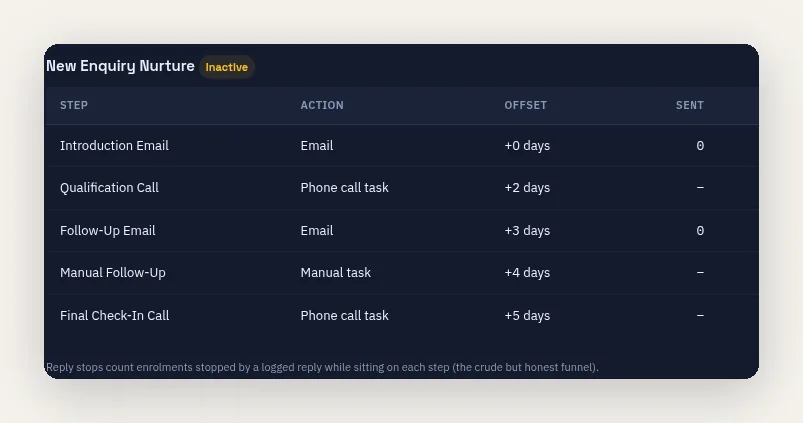
A SAFE CRM follow-up sequence called New Enquiry Nurture, listing its steps in order: introduction email on day zero, qualification call after two days, follow-up email after three, manual follow-up after four and a final check-in call after five

How sequences work

Three kinds of step

Send an email, create a call task, or create a manual task. Emails use your own templates and branding. Tasks appear in the owner's list on the day they are due.

Enrol by hand or by rule

Put a customer on a sequence yourself, or let rules do it, for example everyone who was sent a quote and has not replied in five working days.

Stop conditions that work

A logged reply, an accepted or declined proposal, or a configured stage change can end the sequence. Open tasks left behind are cleaned up so the list stays honest.

Runs overnight, reports daily

Steps are handled overnight as part of the nightly run. A daily summary email tells you what went out, what was skipped and why.

Send to the right contact

Steps can target a named contact on the account rather than the main billing address, which matters when the decision maker is not the person who pays the bills.

Preview before you trust it

Runs can be reviewed before they send while you get confidence in a new sequence, then switched to fully automatic once you are happy.

Campaigns, when you need to tell everybody

Sequences follow one customer. Campaigns reach many at once. Price rises, end-of-life notices and PSTN switch-off warnings all need the same message sent to a defined slice of your base, with a record of who received it.

  • Build the audience: filter by status, account manager, customer group, or paste a list of account numbers.
  • Preview with reasons: see who would be suppressed and why, before anything is sent.
  • Use a template or compose one: pick an existing correspondence type or write the subject and body for a one-off send.
  • Keep the history: every run records who it reached and what happened, and campaigns link back to the deals they generated.

Because campaigns can be attached to deals and renewal rules, you can answer the question that usually goes unanswered: what did that campaign actually win?

Consent handled properly

Automated sending is where marketing rules get broken by accident. The platform applies them for you on every send, rather than leaving it to whoever built the list.

Messages marked as marketing check consent and suppression for each customer, because the rules differ by customer type. Marketing to an individual, including a sole trader, needs consent or a valid soft opt-in. A corporate subscriber does not, but you still have to identify yourself, offer a way out and honour it (ICO, 2026).

Purpose is what counts. A plain service message is not marketing, but add a promotion to it and it becomes marketing, and sales correspondence often is. Addresses that are unchecked or have bounced are left out, as are customers who have opted out. Each skipped row shows you why.

Sequence Questions and Key Terms

What is a sales sequence?
A sequence is a follow-up plan that runs itself. You set out the steps once, such as an email on day one, a call on day three and another email on day seven. Put a customer on it and the steps happen on time. Nobody has to set reminders. A logged reply, a configured stage change or a proposal decision can stop it.
What kinds of step can a sequence have?
Three: send an email, create a call task, or create a manual task. Emails go out through the platform using your own templates. Tasks land in the deal owner's list on the right day, so the human steps are prompted rather than forgotten.
When does a sequence stop?
When a reply is logged, when the deal moves to a stage you have said should end it, when the proposal is accepted or declined, or when someone stops it by hand. Open tasks from a stopped sequence are tidied up for you, so nobody is left ringing a customer who signed last week.
Will this send marketing emails to people who have not opted in?
No. Steps marked as marketing check consent and suppression before they send. The rules differ by customer type. Marketing to an individual, including a sole trader, needs recorded consent or a valid soft opt-in. A corporate subscriber does not need consent under that rule, but you still have to say who you are, offer a way out and honour it (ICO, 2026). Worth knowing that sales correspondence can count as marketing: it is the purpose and the content that decide, not the label you give it.
What is the difference between a sequence and a campaign?
A sequence follows one customer over time, driven by what they do. A campaign sends one piece of correspondence to many customers at once, such as a price rise notice or a switch-off warning. Both apply the same consent and suppression rules.
Can I check what a campaign will send before it goes?
Yes. You build the audience with filters, preview the list, and see a reason against every row that would be skipped, such as a missing consent, an invalid address or a recent send. The checks run again at the point of sending, so nothing slips through if something changed in between.
Can someone approve correspondence before it is sent?
Yes. Correspondence can be queued for approval, with the queue sitting on the Customer Services dashboard. You choose which types need reviewing. Routine confirmations can go straight out while anything sensitive waits for a second pair of eyes.
Do replies come back into the system?
Replies to a sequence are handled as normal email in your inbox. For proposal questions and customer conversations, replies happen on the web instead, so the whole thread stays attached to the deal or the account rather than living in one person's mailbox. There is no inbound email parsing, which is a deliberate choice: it avoids a class of problems that tends to lose messages quietly.
What does cadence mean in sales?
A cadence is the rhythm of follow-up: how many attempts you make, by which channels, and how far apart. Having one agreed cadence stops a deal stalling simply because nobody remembered the next step.
Next step

Stop Losing Deals to Silence

Book a demo and we will build your follow-up plan as a sequence, then show you what it would have chased last month.