
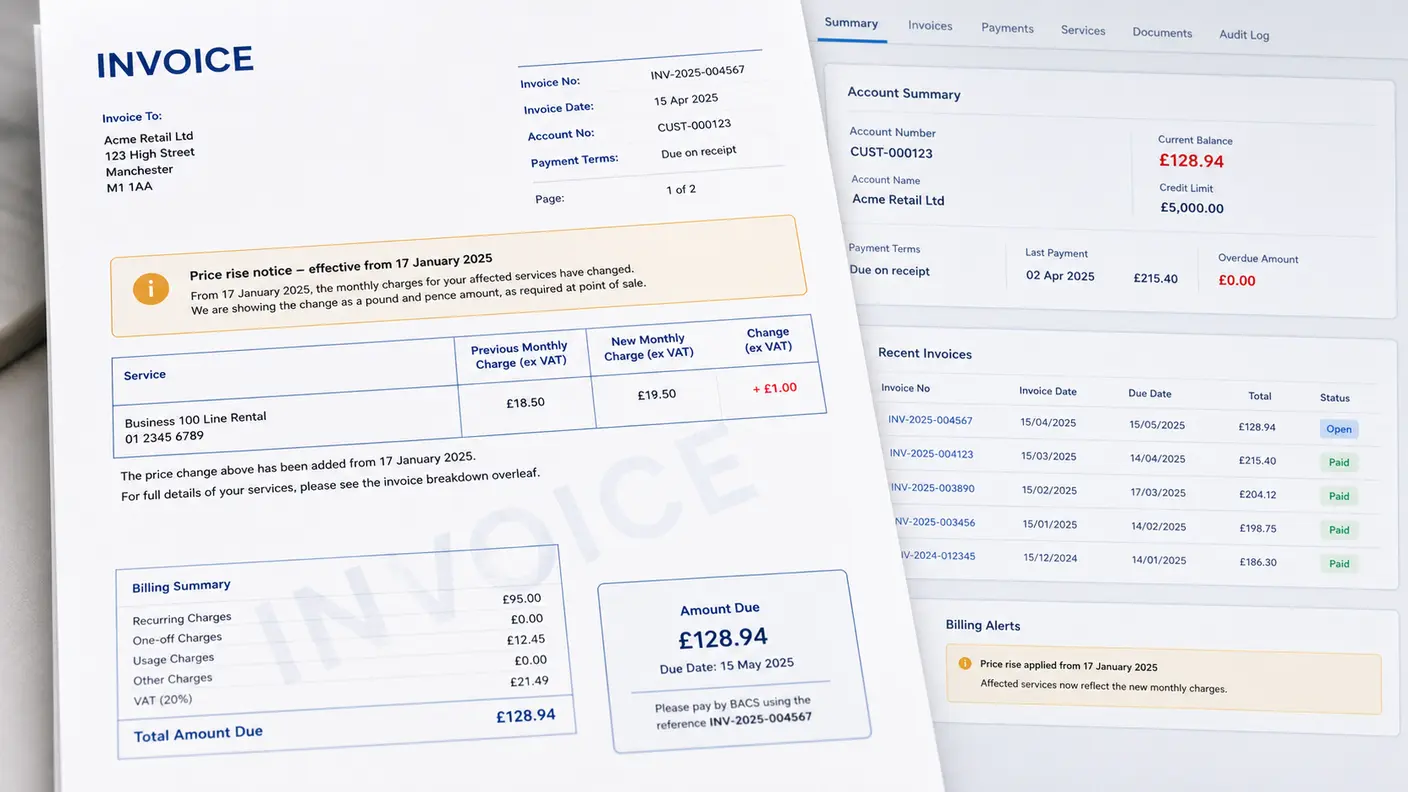
Ofcom Pounds-and-Pence Rules: What Resellers Must Change
Since 17 January 2025, a telecoms contract that provides for a change to the monthly price during the contract period must set that change out in pounds and pence at the point of sale, together with the date it takes effect. Inflation-linked and percentage-based terms such as “CPI plus 3.9%” can no longer be used in new contracts. The requirement applies to residential customers and to small business customers, so it reaches much of a typical reseller’s business base as well as any consumer sales.
The change sits mainly in sales materials and contract terms, with knock-on effects for price-rise letters and the billing run. This post covers the rule, what it means for your contracts, and the part SAFE Billing Platform handles once the new prices are agreed.
Key Takeaways
- Ofcom amended General Condition C1 with effect from 17 January 2025 (Ofcom statement: prohibiting inflation-linked price rises, 2024)
- Any planned change to the monthly price during the contract must be stated at the point of sale as a pounds-and-pence figure, with the date it applies
- The rules cover landline, broadband, mobile and pay TV contracts for residential customers and for microenterprise, small enterprise and not-for-profit customers
- A small business customer negotiating a bespoke agreement can choose to waive these protections
- A price rise the contract does not set out is a contractual modification: the customer must get at least one month’s notice and a right to exit without penalty
- SAFE applies the tariff change when it falls due and can generate per-customer price-rise letters from your own wording
Key terms in this article
What are Ofcom’s pounds-and-pence rules?
Ofcom’s pounds-and-pence rules are amendments to General Condition C1 (contract requirements) that took effect on 17 January 2025. Where a contract provides for the monthly price to change during the commitment period, the new price and the date it applies must be given in pounds and pence before the customer signs, and in the Contract Information and Contract Summary.
Which customers count as small business customers?
Ofcom’s General Conditions define microenterprise, small enterprise and not-for-profit customers separately from residential consumers. For most resellers this covers a large share of business customers, so the contract terms need to record which category each customer falls into.
What Changed in January 2025
Before 17 January 2025, many UK telecoms providers used terms such as “your price will rise by CPI plus 3.9% each April”. Ofcom concluded that customers could not work out at the point of sale what they would actually pay, and amended General Condition C1 rather than relying on its existing rules.
The amended rules require two things. Before the customer is bound by the contract, the provider must draw their attention to the monthly price, any changed monthly price during the commitment period in pounds and pence, and the date from which it applies. The same information must then appear in the Contract Information and Contract Summary. In effect, a contract can no longer provide for an in-contract rise that depends on a future inflation figure.
Ofcom considered capping rises at a maximum figure and did not adopt that approach. The requirement is to state the changed price itself, so wording that only sets a ceiling (“may rise by up to £X”) does not meet it.
A provider can still raise prices in a way the contract does not set out, but that is a contractual modification under the existing rules in General Condition C1. The customer must receive at least one month’s notice and can leave without penalty.
Which Customers and Services Are Covered
The rules apply to landline, broadband, mobile and pay TV contracts, including bundles. They cover residential customers and small business customers: microenterprise, small enterprise and not-for-profit customers.
A small business customer that negotiates a bespoke agreement can choose to waive its right to the Contract Information and Contract Summary setting out price rises in pounds and pence, and with it the protection of this requirement. A waiver needs to be the customer’s informed choice, so record it with the contract rather than relying on standard terms.
Larger business customers fall outside these rules. Some resellers use the same pounds-and-pence approach for every customer, which keeps one set of templates and one price-rise process.
What to Put in Your Sales Materials and Contracts
For a new contract with a planned in-contract change, the sales materials, the Contract Information and the Contract Summary each need the changed monthly price and the date it applies. For example:
- “Your monthly price is £24.00. From 1 April 2027 it will be £25.50.”
- “Your monthly price is £24.00, rising by £1.50 a month on 1 April each year of your contract.”
Set the figures with your expected cost increases in mind, because a contract cannot pass on more than it states without triggering the customer’s right to exit. Where you set the figure below your actual cost increase, you absorb the difference for the rest of the term.
A renewal is a new contract, so the pounds-and-pence requirement applies to the terms for the next commitment period.
Contracts Signed Before 17 January 2025
The rules apply to new contracts from 17 January 2025. Contracts already in force keep their original price-variation terms until they end or are renewed. Some providers moved existing customers onto pounds-and-pence terms early to run a single process. Where you do that mid-contract, check whether the change counts as a contractual modification that gives the customer a right to exit.
Passing On Wholesale Increases
Openreach and other wholesale suppliers raise their prices during reseller contract terms. A wholesale increase does not create its own exemption: whether you can pass it on, and how, depends on what your contract with the customer says and which category the customer is in. Where the contract does not set out the change in pounds and pence, passing it on is likely to be a contractual modification with notice and exit rights. Take legal advice on the wording before writing to customers in scope.
Whatever the contractual position, stating the change on the notice and the invoice in pounds and pence lets the customer match one to the other. The WLR price rises post on safeonlinebilling.com covers the wholesale side.
Where SAFE Comes In
SAFE Billing Platform does not draft contract clauses or sales wording; those sit with you and your legal review. For the notification and billing side, SAFE includes Ofcom-classification and correspondence-generation tools that produce per-customer price-rise letters against a tariff change, using your own template wording.
The workflow is:
- Define the new tariff in SAFE with the changed amounts.
- Set the effective date.
- Provide your correspondence template with the price-rise wording you want.
- Select the recipients by Ofcom Protection Class (Residential / Consumer, Sole Trader, Micro / Small Enterprise, Not-for-Profit and so on), and the platform merges each customer’s pounds-and-pence change into your template for you to review and send.
- The first billing run after the effective date rates new charges against the new tariff, with pro-rating handled across the switch point.
- The invoice shows the new amounts under the existing line-item structure, so the customer can match the change to the notification they received.
The selection is only as good as the classification on each customer record. Include customers with no Ofcom Protection Class in the mailing until their records are reviewed: SAFE’s guidance for the field is to treat a blank value as requiring protection.
How This Fits With Other Compliance
The pounds-and-pence requirement sits in General Condition C1 alongside the existing rules on contractual modifications, end-of-contract notifications and annual best tariff notifications. General Condition C3 covers billing accuracy and adequate billing information. The UK telecoms compliance guide on safeonlinebilling.com covers the wider Ofcom picture.
Putting It Together
Pounds-and-pence wording in your sales materials and contract terms is your work, as is the price-rise letter template. SAFE merges each customer’s figures into that template. You configure the tariff in SAFE with the new amounts and an effective date, and the next billing run applies it, with the change visible on the invoice.
To check how a price change would run against your own tariffs and customer classifications, arrange a demonstration.
Dr Paul Barrass
Founder & Technical Director, Safe Online Billing
Paul founded Safe Online Billing in 2005 and has built telecoms billing software for UK resellers for over 20 years. About the team →